Contact us
Contact us
We'd love to hear from you
We would be delighted to hear from you.
Feel free to email us at: [email protected]
or fill in the form below:
Frequently Asked Questions
Take a look at some of things we often get asked. If you can't find what you're looking for, fee free to reach out using the form above.
What is the Horse Rider’s Confidence & Resilience Journal?
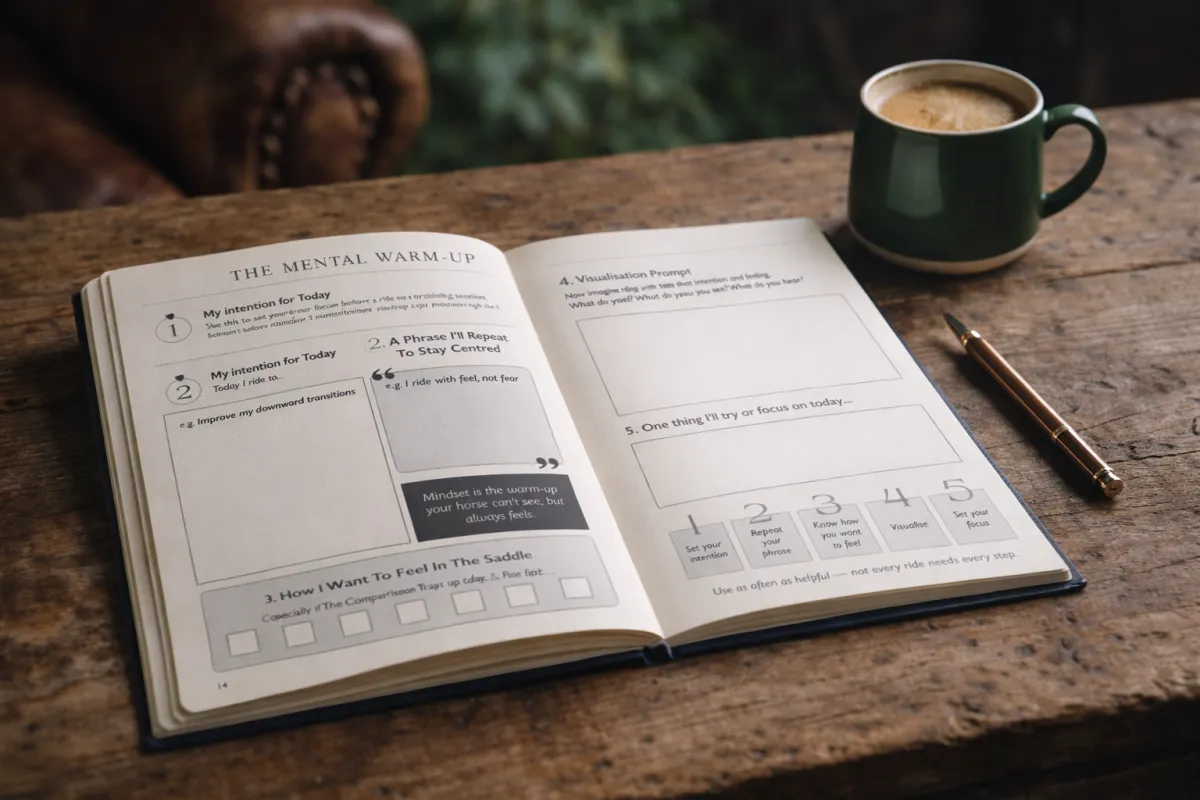
The Horse Rider’s Confidence & Resilience Journal is a guided mindset journal designed to help riders reflect on their rides, manage overthinking, and build confidence in the saddle over time. It includes structured prompts and exercises that help riders process mistakes, recognise progress, and develop a stronger riding mindset.
Who is this journal for?
This journal is designed for riders of all disciplines who want to improve the mental side of their riding. Whether you ride dressage, showjumping, eventing, showing, or riding club activities, the journal helps you reflect on your experiences and build confidence ride by ride.
Do I need to use the journal every day?
Not at all. Many riders use the journal after rides, lessons, or competitions. The prompts are designed to be flexible so you can reflect whenever it feels helpful.
Is this journal suitable for beginner riders?
Yes. The journal is suitable for riders at all stages of their journey. Whether you are just starting out or competing regularly, the mindset tools can help you build confidence and perspective.
Where can I buy the journal?
The Horse Rider’s Confidence & Resilience Journal is currently available in paperback on Amazon.
Is there a digital version available?
At the moment the journal is available in paperback format. Additional digital tools and resources are available through The Equestrian Edit website.
Do you offer other rider journals?
Yes. The Equestrian Edit is developing a range of journals and tools designed to support riders across different disciplines and areas of equestrian life.
Can I contact you with questions?
Absolutely. If you have any questions about the journal or The Equestrian Edit, feel free to get in touch using the contact form on this page.
Why do horse riders lose confidence?
Horse riders can lose confidence for many reasons, and it’s a very common part of the sport. Confidence often drops after difficult experiences such as a fall, a challenging ride, a mistake in competition, or when progress feels slower than expected.
However, confidence issues are not always caused by one major event. Many riders gradually lose confidence through repeated overthinking, comparing themselves to others, or focusing only on what went wrong instead of recognising progress.
Because riding involves working with another living animal, uncertainty and unpredictability are part of the journey. Developing a strong mindset and learning how to reflect on rides with perspective can help riders rebuild confidence and continue improving over time.
How do I stop overthinking my riding mistakes?
Overthinking riding mistakes is very common, especially for riders who care deeply about improving. One helpful approach is to separate the facts of what happened from the story your mind creates about it.
For example, the fact might be that you chipped into a fence or had a tense transition. The story might become “I’m not good enough” or “I should be further along by now.”
Learning to reflect on rides calmly, focusing on what actually happened, what went well, and what you can try next time can help break the overthinking cycle and rebuild confidence over time.
How can I build confidence in horse riding?
Confidence in riding is usually built through a combination of experience, reflection, and supportive training. Riders often build confidence by breaking challenges into smaller steps, recognising progress, and focusing on learning rather than perfection.
It can also help to develop routines that support your mindset, such as setting intentions before riding, reflecting after lessons, and recognising moments of improvement that might otherwise go unnoticed.
Confidence tends to grow gradually as riders learn to trust both their skills and their partnership with their horse.
Why do riders compare themselves to others so much?
Comparison is common in many sports, and horse riding is no exception. Riders often see the polished moments of others — such as successful rounds or calm warm-ups — without seeing the challenges, mistakes, and difficult days behind the scenes.
This can create the impression that everyone else is progressing faster or riding more confidently. In reality, most riders experience similar doubts and learning curves along the way.
Developing awareness of this “comparison trap” can help riders refocus on their own progress and the unique journey they are on with their horse.
How do I recover from a bad ride?
A difficult ride can feel frustrating, but it can also be one of the most valuable learning experiences. After a challenging ride, it can help to take a step back and reflect calmly on what actually happened.
Many riders find it useful to ask themselves a few simple questions: What went well? What did I learn? What might I try differently next time?
Approaching rides with curiosity instead of criticism can help riders move forward with greater confidence and perspective.
Is mindset really important in horse riding?
Yes, mindset plays a significant role in riding. Horses are sensitive animals that respond not only to physical aids but also to a rider’s tension, confidence, and focus.
A rider who is calm, clear, and present often communicates more effectively with their horse. Developing a strong mindset can help riders stay focused, recover more quickly from mistakes, and continue improving over time.
Many riders find that learning to manage the mental side of the sport makes riding more enjoyable and less stressful.
What should I write in a horse riding journal?
A horse riding journal can help riders reflect on their progress, track learning, and build confidence over time. Many riders use a journal after lessons, training sessions, or competitions to capture both practical and mental aspects of their rides.
Some helpful things to include in a riding journal are:
• What happened during the ride or lesson
• What went well and felt positive
• Challenges or moments that felt difficult
• What you learned from the experience
• One thing to focus on next time you ride
• Moments that helped build your confidence
Recording these reflections regularly can help riders notice patterns, recognise improvement, and approach future rides with more clarity and perspective.
Over time, this kind of reflection can become a powerful tool for developing both riding skills and a stronger mindset in the saddle.
The Horse Rider’s Confidence & Resilience Journal was designed to guide riders through this type of reflection with structured prompts that make it easier to process rides and build confidence over time.
How do riders deal with nerves before riding?
Feeling nervous before riding is very common, especially before lessons, competitions, or when trying something new. In many cases, nerves simply mean that the rider cares about doing well and wants the ride to go smoothly.
One helpful way to manage nerves is to focus on preparation rather than outcome. Many riders find it useful to take a few moments before mounting to slow their breathing, set a simple intention for the ride, and remind themselves what they want to focus on.
It can also help to break the ride down into small steps instead of thinking about everything at once. Focusing on rhythm, position, or connection with the horse can help bring attention back to the present moment.
Over time, developing routines such as mental warm-ups, reflection after rides, and recognising small improvements can help riders feel calmer and more confident in the saddle.
Nerves are a natural part of learning in any sport, but with the right mindset tools, riders can learn how to manage them and ride with greater clarity and confidence.
Many riders also find that reflecting on their rides regularly helps reduce nerves and build confidence over time. The Horse Rider’s Confidence & Resilience Journal was created to guide riders through that process.
Helping riders keep perspective in a sport that constantly challenges it.
The Equestrian Edit
The Equestrian Edit creates thoughtful journals and mindset tools designed to support riders both in and out of the saddle. Our products help riders stay organised, build confidence, and enjoy the process of learning with their horses.

