How to Stop Overthinking in Horse Riding
How to Stop Overthinking in Horse Riding
If you ride horses, you probably know this feeling.
You finish a ride, load the horse, and drive home… but your mind is still in the arena.
You replay one moment.
The missed stride.
The pole.
The awkward transition.
The comment from your trainer.
Hours later, the moment is still looping.
What began as a small mistake quietly becomes something bigger:
“Why did I do that?”
“I should be riding better by now.”
“Everyone else looked more confident.”
For many riders, the hardest part of riding isn’t the physical skill.
It’s learning how to manage the thinking that happens afterwards.
If you find yourself overthinking rides, you're not alone. And more importantly, you're not broken.
Overthinking is a very common pattern in performance environments — especially in sports like riding where performance, identity, and partnership all overlap.
The good news is that once you understand the pattern, you can learn how to interrupt it.
Why Riders Overthink So Much
Riding is a unique sport.
It combines several psychological pressures at once:
Performance in front of others
Responsibility for another animal
Visible mistakes
Emotional investment in progress
Because of this, the brain treats riding moments as highly meaningful events. When something goes wrong, the brain doesn’t simply record the event. It tries to interpret it.
A small moment quickly becomes a conclusion.
You miss a stride.
The brain interprets it as:
"I'm inconsistent."
You have a tense warm-up.
The brain decides:
"I always ride so much worse at a competition."
The event itself may have been minor, but the meaning attached to it becomes much bigger.
This pattern is something I call The Meaning Gap™ — the space between what actually happened and the story your mind creates about it.
And that gap is where overthinking lives.
Why Your Brain Keeps Replaying the Ride 🧠
Many riders assume that overthinking means they are being negative or weak.
In reality, the brain is trying to help.
Its goal is to:
Prevent future mistakes
Protect you from embarrassment
Improve performance
The problem is that the brain often chooses the wrong strategy. Instead of calmly reviewing the event, it amplifies it.
One mistake becomes:
"What if this keeps happening?"
Then:
"Maybe I'm holding my horse back."
Then:
"Everyone else seems to be better than me."
At that point the brain is no longer analysing the ride. It is analysing your identity as a rider.
This is why the spiral can feel so intense.
The Comparison Trap Riders Fall Into
Overthinking often becomes worse when comparison enters the picture.
At shows, lessons, or even at the yard, riders naturally observe each other.
You see:
Calm warm-ups
Smooth rounds
Relaxed conversations
What you don’t see is:
Their nerves
Their mistakes yesterday
The difficult rides at home
Their internal self-doubt
So you end up comparing:
your internal experience
to
someone else's external appearance
That comparison is based on incomplete information, but the brain treats it as evidence.
The result is a distorted picture where everyone else appears confident and you appear flawed.
This pattern is known as The Comparison Trap™, and it is one of the most common triggers of overthinking in riding.
How to Stop Overthinking After a Ride
Stopping overthinking doesn't mean forcing yourself to “be positive.”
In fact, trying to suppress thoughts often makes them stronger.
What works better is structured perspective.
Instead of letting the brain run freely, you guide it through a simple reset process.
A helpful structure is:
1. Identify the Facts
Start by separating facts from interpretation.
Ask yourself: What actually happened?
For example: We chipped into the fence and had a pole.
That is a fact.
Statements like: “I'm so inconsistent.” are interpretations.
This separation immediately reduces emotional intensity.
2. Acknowledge the Feeling
Next, identify the emotion that appeared.
Common ones include:
Frustration
Embarrassment
Disappointment
Pressure
Naming the emotion helps the brain regulate it.
Research in neuroscience shows that labelling emotions reduces their intensity and restores clearer thinking.
3. Decide What Is Useful Next
Finally, ask:
What would actually help my next ride?
Examples might include:
Maintaining rhythm
Looking earlier to the fence
Riding more forward
Focusing on your breathing
This step shifts the brain from self-criticism to problem solving. And that is where progress happens.
The Long Game of Riding
One reason overthinking is so common in riding is that progress rarely appears dramatic. Improvement happens slowly. One ride feels the same as the last.
But across months or seasons, small changes accumulate:
The horse becomes more relaxed
Distances become clearer
Confidence grows quietly
Unfortunately, the brain remembers mistakes more vividly than improvement. Psychologists call this negativity bias. Because of this bias, riders often underestimate their progress.
Zooming out can help.
Ask yourself:
Where was I six months ago?
What feels easier now than it once did?
The answers are often more encouraging than the mind initially believes.
A Practical Way to Reset Your Thinking
Understanding these patterns is the first step. But riders often need something simple they can use in real time — before, during, or after a ride. That’s where structured tools can help.
A short mental reset that separates:
Fact → Feeling → Forward
can bring perspective back surprisingly quickly.
Many riders find that even two or three minutes of structured reflection is enough to stop the spiral and return to clearer thinking.
Final Thoughts
Overthinking doesn't mean you're weak. It usually means you care deeply.
You care about your horse.
You care about improving.
You care about doing the sport well.
But care without perspective can quietly turn into pressure. The riders who last in this sport are not the ones who never wobble. They are the ones who learn how to reset when their mind begins to spiral.
Because perspective is not something riders are born with.
It's something they practise.
Ride by ride.
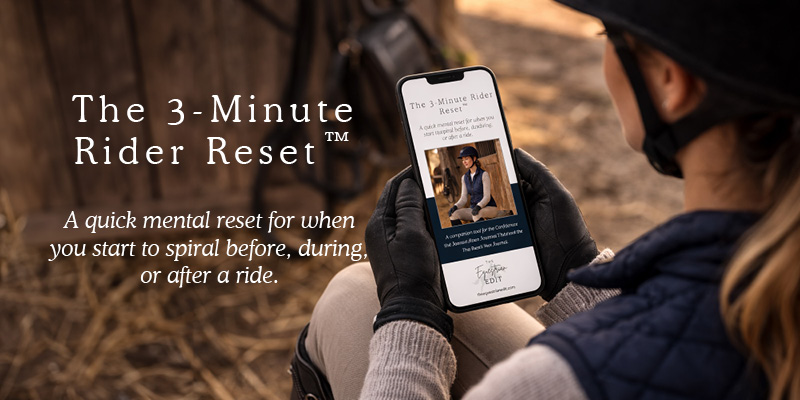
Struggling with overthinking your riding?
he 3-Minute Rider Perspective Reset™ is a simple tool designed to help riders regain perspective before the spiral begins.