The Science Behind Equestrian Competition Nerves
Equestrian Mindset, Rider Confidence, Performance Psychology
The Science Behind Equestrian Competition Nerves
Why your brain reacts the way it does – and why understanding it is the first step towards riding with more confidence.
You've had a great week of riding.
Your horse feels relaxed.
You've practised your test, your course, or your show routine more times than you can count, almost to the point of boredom.
Your horse probably knows it as well as you do.
Then competition day arrives.
As you pull into the venue, something changes.
Your heart starts beating faster.
Your breathing becomes shallower.
Your shoulders creep towards your ears.
Your stomach feels unsettled.
Your legs suddenly seem to have forgotten how to work.
You haven't even taken your horse off the box yet.
So what happened?
The answer is reassuring.
Nothing is wrong with you.
Your brain is simply doing what it evolved to do.

Your brain doesn't know the difference between "important" and "dangerous"
One of the biggest misconceptions about competition nerves is that they mean you've lost your confidence.
They don't.
They simply mean your nervous system has decided that today matters.
Thousands of years ago, your brain evolved to keep you alive by constantly scanning for anything that might threaten your safety.
Today, that same system can't always tell the difference between genuine danger and situations that simply feel important.
Competitions combine many of the things our brains naturally pay attention to:
Uncertainty
Being watched by others
Wanting to perform well
Fear of making mistakes
Fear of letting others down including your horse
To your logical mind, it's just another dressage test or showjumping round.
To your nervous system, it's an event worth paying attention to, so it prepares you.
Why your body suddenly feels different
Once your brain decides something is important, your nervous system springs into action. Your heart beats faster to pump more oxygen around your body. Your breathing changes. Your muscles become more alert. Your vision narrows. Your mind starts scanning for problems before they've happened.
These changes aren't designed to sabotage you, they're designed to help you survive.
The problem is...
They're not especially helpful when you're trying to remember your dressage test or ride an accurate line to a fence.
As adrenaline rises, it becomes harder to think clearly so you begin overthinking, second-guessing, and trying to control everything. Ironically, the harder you try to stop feeling nervous, the more attention you give the nerves themselves.
💡 Pro Tip: Next time you start to feel competition nerves take hold, pause for a moment and ask yourself: "What is my nervous system trying to protect me from?" That simple question shifts you from self-criticism to understanding—and understanding is where confidence begins.

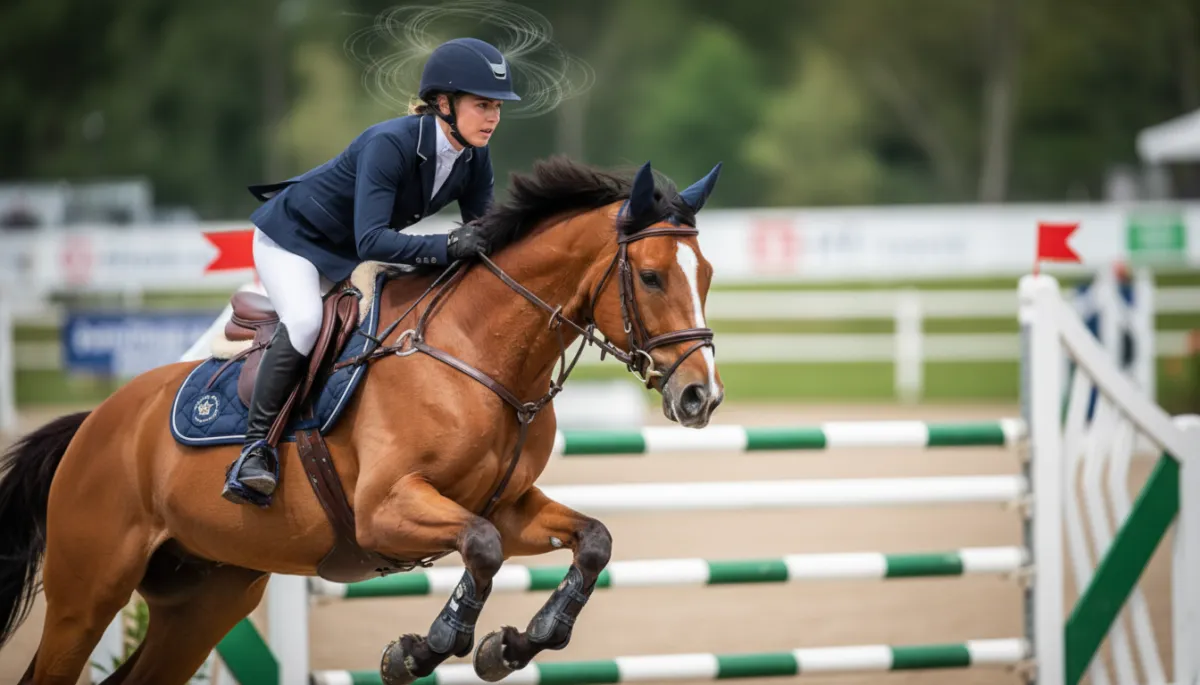
Simple breathing exercises in the saddle can retrain your nervous system to stay calm under show pressure.
Horse Riding Anxiety: Why Your Horse Feels What You Feel
One of the things that makes riding different from many other sports is that you're only one half of the partnership. Horses are incredibly sensitive to changes in our breathing, muscle tone, balance and energy.
If your breathing becomes shallow...your shoulders tighten...your hands become fixed...and your horse notices.
That doesn't mean your nerves "cause" your horse to become tense, but they can influence the conversation you're having together.
I've always loved this simple reminder:
What goes on in the brain travels down the rein.
The calmer and clearer your nervous system becomes, the easier it is for your horse to understand what you're asking.
📌 Key Takeaway: Calming your mind is not just for you – it directly shapes how safe and rideable your horse feels in a busy show environment.
The good news: your brain can learn
Here's the part I find most encouraging: Your nervous system isn't fixed. It learns through experience.
Every time you have a positive competition experience, even a small one, you give your brain new evidence that competitions can be safe. That's why confidence isn't built by waiting until you stop feeling nervous. It's built by gently teaching your nervous system that you can cope, even when nerves show up.
And don't underestimate the power of noticing small wins. Initially you might feel ridiculous even considering them as a "win" but they matter. Accumulating small wins gives your nervous system evidence. It could be something as simple as:
Finishing your warm-up feeling calmer.
Breathing before entering at A.
Recovering well after a mistake.
Those moments are how confidence grows.
Practical Performance Psychology Tools for Competition Nerves
Think of them as working with your nervous system to give it the evidence it needs to settle.
1. Breathe out for longer than you breathe in
When we feel anxious, we naturally shorten our breathing.
Deliberately slowing your exhale sends a message to your nervous system that you're safe.
Try breathing in for four counts and out for six as you walk your horse or wait for your turn.
2. Focus on process, not outcome
Instead of asking: "I hope I don't mess this up."
Choose one simple goal you can control.
Something like:
Ride accurate corners.
Keep your hands soft.
Breathe before every transition.
Ride positively to each fence.
Those goals stay within your control regardless of the final score.
3. Remember that nerves aren't the enemy
This is probably the biggest mindset shift of all. The goal isn't to eliminate competition nerves, it's to understand them and work with them.
A racing heart doesn't mean you're incapable.
Butterflies don't mean you've lost your confidence.
They simply mean your nervous system has recognised that today matters.
Once you stop fighting your body's response, you free up far more energy for riding your horse.
Final Thoughts
Competition nerves don't mean you're broken. They don't mean you've suddenly forgotten how to ride and they certainly don't mean you lack confidence. More often than not, they mean you care.
The good news is that your brain can learn.
With understanding, repetition and self-compassion, your nervous system begins to recognise competitions as familiar rather than threatening. That's when confidence starts to feel less like something you're chasing, and more like something you're building.
Want to understand your brain even more?
If this article resonated with you, you'll find these ideas explored in much greater depth in Fear Is Not the Final Fence.
The book explains why fear, overthinking and self-doubt show up in the saddle, and gives you practical, science-backed tools to help you work with your brain rather than against it, so you can rebuild your confidence and enjoy riding again.